
Blog
Perfume Notes Explained: Top, Middle & Base Notes Guide

Have you ever sprayed a perfume at a store, loved the initial smell, bought it, and then found yourself confused an hour later because it smelled completely different? Or perhaps you’ve wondered why some fragrances seem to vanish after breakfast while others linger on your favorite sweater for days.
The secret lies in the fragrance notes.
Perfume is not just a single, static smell; it is a dynamic, evolving composition. Like a musical symphony, a well-crafted fragrance is made up of different “notes” that play at different times. Understanding these notes—Top, Middle, and Base—is the key to decoding the mystery of scent. It helps you predict how a perfume will wear, how long it will last, and whether it’s the right match for your personality.
In this guide, we will break down the olfactory pyramid, explain the science of scent evolution, and help you become a savvy fragrance chooser.
What Are Perfume Notes? The Olfactory Pyramid
At its core, perfume is a blend of various raw materials (essential oils, aroma chemicals, and fixatives) dissolved in alcohol and water. But these materials don’t all behave the same way. Some are light and fly off the skin instantly; others are heavy and stick around for hours.
Perfumers use a concept called the Olfactory Pyramid to structure these ingredients based on their volatility—how quickly they evaporate.
Top Notes (The Head): The lightest molecules. They evaporate fastest.
Middle Notes (The Heart): The medium-weight molecules. They emerge as the top fades.
Base Notes (The Foundation): The heaviest molecules. They evaporate slowly and provide longevity.
When you wear a high-quality fragrance, such as those crafted by Auralis5, you aren’t just smelling one thing; you are experiencing a journey through these three layers.
1. Top Notes: The First Impression
Duration: 5 minutes to 30 minutes.
The top notes are what you smell immediately after spraying a perfume. They are the “greeting” or the “handshake” of the fragrance. Because they are made of tiny, light molecules, they are highly volatile and evaporate very quickly.
The Role of Top Notes
Their primary job is to captivate you. They provide that initial burst of freshness and set the mood for the experience. However, because they are fleeting, it is a rookie mistake to buy a perfume based only on the top notes. You must wait to see what lies beneath.
Common Top Note Ingredients
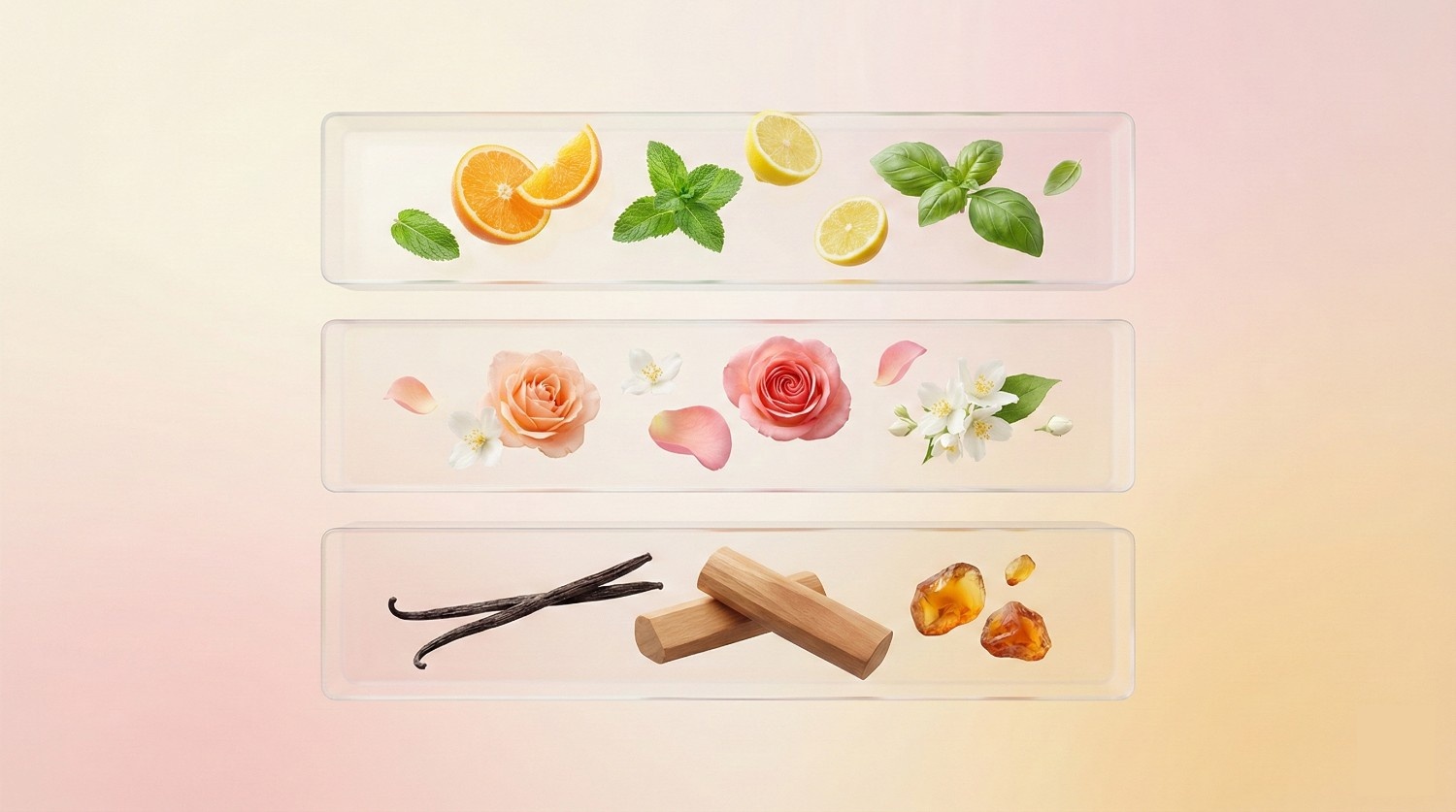
Citrus: Lemon, Bergamot, Grapefruit, Mandarin, Lime.
Fruits: Berries, light Melon, Green Apple.
Fresh Herbs: Basil, Lavender (sometimes), Mint, Eucalyptus.
Aldehydes: Airy, soapy, or metallic synthetic notes that add “sparkle.”
Example in Action: Imagine peeling a fresh orange. That zesty, bright spray of scent that hits your nose immediately? That is a classic top note experience.
2. Middle Notes: The Soul of the Scent
Duration: 30 minutes to 4 hours.
As the top notes begin to fade, the “Heart Notes” (or Middle Notes) start to bloom. This is the core of the fragrance—the true personality of the perfume. These notes make up anywhere from 40% to 80% of the total fragrance composition.
The Role of Middle Notes
The heart notes serve as a buffer. They smooth out the transition between the sharp, fresh opening and the deeper, heavier base. This is the scent you will smell on yourself for the majority of the day. If you don’t like the heart notes, you don’t like the perfume.
Common Middle Note Ingredients
Florals: Rose, Jasmine, Ylang-Ylang, Violet, Peony, Geranium.
Spices: Cinnamon, Cardamom, Nutmeg, Black Pepper, Clove.
Greens: Grass, Leafy notes, Petitgrain.
Fruity (Heavier): Peach, Apricot, Pineapple.
Why They Matter: The heart notes define the fragrance family. A “Floral” perfume is defined by its heart of rose or jasmine; a “Spicy” perfume is defined by its heart of pepper or cinnamon.
3. Base Notes: The Lasting Foundation
Duration: 4 hours to 24+ hours.
Finally, we reach the dry-down. Base notes are the anchor of the fragrance. They consist of large, heavy molecules that evaporate very slowly. You often won’t smell these fully until the perfume has been on your skin for at least 30 to 60 minutes.
The Role of Base Notes
Base notes provide depth, warmth, and longevity. They effectively “hold” the lighter notes to your skin, preventing them from disappearing too fast. Without base notes, a perfume would vanish in minutes. This is the scent that lingers on your scarf or pillowcase the next day.
Common Base Note Ingredients
Woods: Sandalwood, Cedarwood, Oud, Vetiver, Patchouli.
Resins & Balsams: Amber, Frankincense, Myrrh, Benzoin.
Gourmand: Vanilla, Tonka Bean, Chocolate, Caramel.
Animalic (mostly synthetic now): Musk, Ambergris, Civet, Leather.
Pro Tip: If you want a perfume that lasts all day (high longevity), look for fragrances with prominent wood, musk, or amber base notes.
The Science: Why Does Scent Change?
You now know what the notes are, but why does the scent change? It comes down to Evaporation Rates.
Imagine pouring a bucket of water and a bucket of honey on a hot sidewalk. The water (Top Notes) will disappear almost instantly into steam. The honey (Base Notes) will sit there, sticky and thick, for a long time.
When you spray perfume on your skin, your body heat acts as a catalyst.
Phase 1: The heat instantly lifts the lightest molecules (Citrus/Alcohol) into the air.
Phase 2: As the alcohol evaporates completely, the floral and spicy oils begin to oxidize and interact with your skin’s unique chemistry (pH level).
Phase 3: Eventually, only the heaviest resins and woods remain, binding with the natural oils of your skin to create a “skin scent.”
This evolution is why high-quality perfumes, like those found at Auralis5.com, are so fascinating. They aren’t flat or one-dimensional; they are alive and changing throughout the day.
How Notes Affect Longevity
One of the most common questions beginners ask is: “Why doesn’t my perfume last?”
Often, the answer lies in the dominant notes you chose.
Citrus & Fresh Scents: If you buy a perfume that is described as “Fresh,” “Aquatic,” or “Citrusy,” it is composed mostly of Top Notes. By scientific design, these molecules evaporate fast. You can expect 2–4 hours of wear time.
Floral & Spicy Scents: These rely heavily on Heart Notes. They typically offer moderate longevity, lasting 4–6 hours.
Oriental, Woody & Gourmand Scents: These are packed with Base Notes (Vanilla, Oud, Amber). These molecules are stubborn “fixatives.” They can last 8–12+ hours on the skin.
The Importance of Balance
A great perfume isn’t just about loading up on base notes (which can be too heavy) or top notes (which vanish). It’s about balance. Brands like Auralis5 excel at blending these tiers seamlessly. They ensure the fresh opening transitions smoothly into a lasting base, giving you the best of both worlds: an energetic start and a long-lasting signature trail.
How to Test Perfume Like a Pro
Now that you understand the pyramid, you can change how you shop for fragrance.
Spray and Wait: Never buy immediately after spraying.
The 15-Minute Rule: Spray the scent on a blotter or your wrist and walk away. Do some other shopping. After 15 minutes, the Top Notes have settled, and the Heart Notes are emerging. Do you still like it?
The Dry-Down Test: If you’re serious about a scent, wear it for a full day. See how the Base Notes develop after 4 hours. Does it turn powdery? Musky? Sweet?
Check the Description: Look at the note breakdown. If you see “Bergamot, Lemon, Green Tea,” expect a fresh, shorter-lasting scent. If you see “Sandalwood, Amber, Vanilla,” expect a warm, long-lasting powerhouse.
Frequently Asked Questions (FAQs)
Q: Why can I smell the top notes on paper but not on my skin?
A: Paper is neutral and holds onto scent longer than skin. Your skin is warm and has its own oils, which accelerates evaporation. This is why testing on skin is crucial—it’s the only way to know how the “Heart” and “Base” will truly smell on you.
Q: Do all perfumes have Top, Middle, and Base notes?
A: Most traditional perfumes do. However, some linear fragrances are designed to smell the same from start to finish. Additionally, some modern molecular fragrances (like those using Ambroxan) may flicker in and out rather than following a traditional pyramid.
Q: Can I make my top notes last longer?
A: It is difficult to fight physics, but you can help! Apply an unscented moisturizer before your perfume. Hydrated skin holds volatile molecules better than dry skin. Also, applying to cooler areas (like hair or clothes) rather than hot pulse points can slow down the evaporation of top notes.
Q: What are “Linear” vs. “Non-Linear” scents?
A:
Non-Linear: The scent changes drastically over time (The Pyramid effect).
Linear: The scent smells exactly the same at hour 6 as it did at minute 1. Neither is “better,” but non-linear scents are generally considered more complex and sophisticated.
Conclusion: Start Your Olfactory Journey
Understanding the mechanics of Top, Middle, and Base notes transforms perfume from a simple cosmetic into an art form. It allows you to appreciate the storytelling of a scent—the bright, exciting introduction, the emotional heart, and the lingering memory of the base.
When you are ready to find a scent that offers this complexity without the designer markup, explore the collection at Auralis5.com. Whether you are looking for a zest-filled top note for energy or a vanilla-heavy base for comfort, Auralis5 offers premium inspired fragrances that respect the delicate art of the olfactory pyramid.
Smell is the most memorable of all senses. Choose a fragrance that tells your story from top to bottom.