
Blog
How to Apply Perfume Correctly for Long-Lasting Fragrance

You’ve found your signature scent. It’s perfect—complex, alluring, and exactly “you.” You spray it on in the morning, ready to conquer the day. But by lunchtime, it has vanished. You ask a colleague if they like your perfume, and they lean in awkwardly, sniffing the air, only to shake their head. “I can’t smell anything.”
It is a frustrating scenario that happens to almost everyone. But before you blame the bottle, consider your technique.
The truth is, applying perfume is an art form. It is not just about what you wear, but how you wear it. The longevity of a fragrance relies on a combination of chemistry, placement, and skin preparation. Even the most expensive luxury bottle will fall flat if applied to dry skin or rubbed vigorously.
In this comprehensive guide, we will master the mechanics of scent application. From the science of pulse points to the secrets of layering, here is how to make your fragrance last from your morning coffee to your evening commute.
1. Preparation: The Secret is in the Skin
The biggest enemy of perfume longevity is dry skin.
Think of your skin like a sponge. If a sponge is bone dry, water will bead up on the surface and evaporate quickly. If the sponge is slightly damp, it absorbs and holds liquid much better. Fragrance works the same way.
The Moisturizer Hack
For maximum staying power, your skin needs to be hydrated. Fragrance oils need something to “cling” to.
Unscented Lotion: Apply a neutral, fragrance-free lotion immediately after your shower. Let it sink in for a minute, then apply your perfume. The oils in the moisturizer will lock the scent molecules to your skin.
The Vaseline Trick: For an extra longevity boost, dab a tiny amount of petroleum jelly (Vaseline) on your pulse points before spraying. The jelly creates an occlusive barrier that prevents the fragrance oils from sinking too deep into your pores or evaporating too fast.
Pro Tip: The best time to apply perfume is right after a shower. Your pores are open from the steam, and your skin is warm and hydrated, making it the perfect canvas for absorption.
2. Mapping the Pulse Points: Where to Spray
You have likely heard the advice to spray on your wrists, but do you know why?
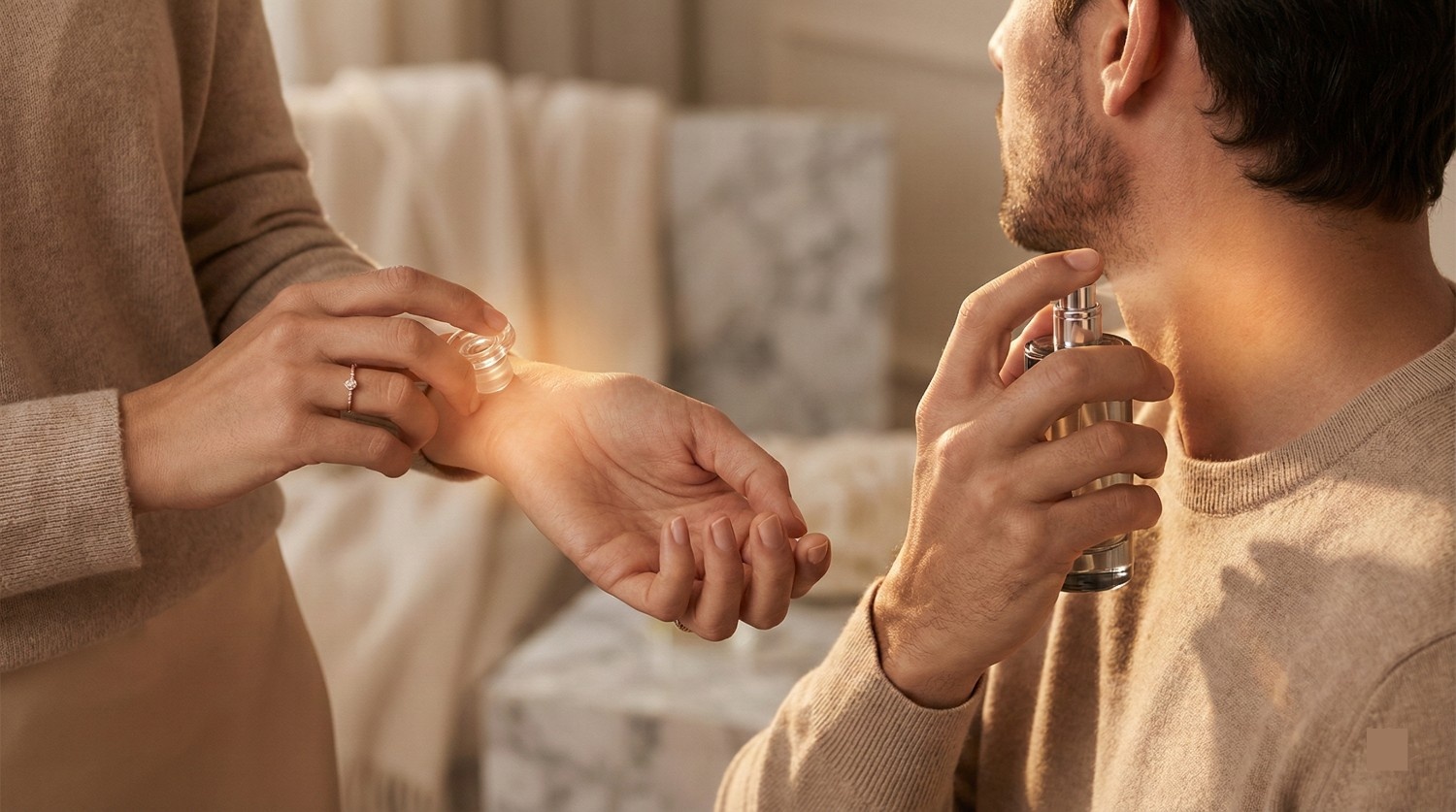
Pulse points are areas on your body where the blood vessels run closest to the skin. These spots radiate heat. This warmth acts as a natural diffuser, pushing the scent off your skin and into the air around you throughout the day.
To create an encompassing “scent bubble,” target these key areas:
The Classics
Wrists: The most common spot. Your hands move constantly, creating a trail of scent as you gesture.
Behind the Ears / Neck: This is the intimate zone. It creates a subtle cloud for people who lean in for a hug or a conversation.
The Hidden Gems
Inner Elbows: A high-heat area that is often less exposed to friction than wrists. It’s excellent for long-term diffusion.
Behind the Knees: Scent rises. By applying perfume to your lower body, the warmth will carry the fragrance upward, enveloping you in a full-body aura. This is especially effective in summer when your legs are exposed.
Collarbone: Ideal for button-down shirts or open necklines. It allows the scent to waft up toward your own nose.
A Note on Quality
Even the best placement can’t save a weak formulation. To get the most out of these pulse points, ensure you are using a fragrance with a sufficient oil concentration. High-quality inspired perfumes, like those from Auralis5, are formulated to take full advantage of body heat, releasing complex notes slowly over hours rather than evaporating instantly.
3. The Golden Rules of Application
Knowing where to spray is half the battle. Knowing how to spray is the rest. Avoid these common pitfalls to protect the integrity of your scent.
Rule #1: Don’t Rub, Just Tap
This is the most common mistake in the perfume world. You spray your wrist, then immediately rub your wrists together.
Stop doing this.
Rubbing creates friction, which generates heat. This heat breaks down the delicate top notes (the citrus and lighter florals) before they have a chance to settle. It “bruises” the scent, making it smell flat and altering its development. Instead, spray and let it dry naturally. If you feel too wet, gently tap your wrists together once—but never rub.
Rule #2: Distance Matters
Don’t hold the bottle right against your skin. This creates a concentrated puddle that can drip. Instead, hold the bottle 3 to 6 inches away from your skin. This ensures the atomizer creates a fine mist, covering a larger surface area evenly. The wider the coverage, the better the projection.
Rule #3: Clothing vs. Skin
Should you spray your clothes?
The Pros: Fabric holds scent much longer than skin because it is cooler and doesn’t sweat. Your coat or scarf can smell like your perfume for weeks.
The Cons: Perfume oils (especially darker ones like vanilla or amber) can stain delicate fabrics like silk or white cotton. Also, on fabric, the scent won’t evolve. You will mostly smell the top notes and heart notes, missing the dry-down.
The Verdict: Apply to your skin first for the chemistry, then add a light mist to the lining of your jacket or your scarf for longevity.
4. Dosage: How Much is Too Much?
Finding the right balance between “unnoticeable” and “suffocating” takes practice. The magic number usually depends on the concentration of your bottle.
Eau de Cologne (EDC) / Body Mist: You can be generous. 4-6 sprays are often needed as these are very light.
Eau de Toilette (EDT): The standard daily wear. 3-4 sprays (Wrists, Neck) are usually sufficient.
Eau de Parfum (EDP) & Parfums: These are potent. Brands that focus on high concentrations, such as Auralis5, pack a lot of power into a single spray. With premium EDPs, start with 2 sprays (one on the neck, one on a wrist). Wait 20 minutes to see how it settles before adding more.
The “Nose Blindness” Danger: Be careful of “olfactory fatigue.” After wearing the same scent for weeks, your brain tunes it out. You might think the scent has faded and over-apply, choking out your coworkers. Trust the 2-3 spray rule, even if you can’t smell it strongly anymore.
5. Storage: Where Your Perfume Goes to Die
You might be applying it perfectly, but if you store your perfume in the bathroom, you are destroying it.
Heat, humidity, and light are the enemies of fragrance. The fluctuating temperature of a bathroom (hot showers, cool air) breaks down the chemical bonds in the perfume, causing it to turn sour or lose its potency.
The Ideal Storage Spot:
A cool, dark place.
A bedroom drawer, a closet shelf, or a dedicated vanity box.
Keep the bottle in its original box if possible to block out UV light.
By storing your collection properly, you ensure that every drop remains as potent as the day you bought it.
6. Layering for Depth
If you want a scent that truly sticks, try “scent layering.” This involves using multiple products with similar or complementary profiles.
Wash: Use a scented body wash.
Hydrate: Use a matching or complimentary body lotion.
Spray: Apply your Eau de Parfum.
For example, if you are wearing a vanilla-based perfume, use a vanilla or cocoa butter lotion first. This creates a “base layer” that amplifies the main event.
7. Choosing the Right Perfume for Longevity
Ultimately, application technique can only do so much if the perfume itself is weak. The composition of the fragrance plays a massive role in how long it lasts.
Look for Base Notes: Fragrances heavy in woods, musk, oud, amber, and leather naturally last longer because the molecules are heavier.
Check the Quality: Not all “Inspired” brands are created equal. Some dilute their formulas heavily with alcohol to cut costs.
This is why savvy fragrance lovers turn to Auralis5.com. By focusing on maintaining the integrity of the scent profile and using high-quality ingredients, Auralis5 fragrances offer the depth and endurance of luxury designer scents. When you start with a robust product, your application techniques will yield much better results.
Frequently Asked Questions (FAQs)
Q: Does perfume expire?
A: Yes, but it takes a long time. An unopened bottle can last 3-5 years or more. Once opened, if stored correctly (cool, dark place), it should last 2-3 years. If the liquid changes color (darkens) or smells sour/vinegary, it has turned.
Q: Why does perfume last longer on my friend than on me?
A: Skin chemistry is unique. Oily skin holds fragrance better than dry skin. Additionally, diet, hormones, and pH balance can affect how a scent projects and endures. If you have dry skin, the moisturizer trick is essential for you.
Q: Can I spray perfume in my hair?
A: Yes, hair holds scent incredibly well! However, the alcohol in perfume can dry out your hair.
Safe Method: Spray the perfume onto your hairbrush, let the alcohol evaporate for 10 seconds, then brush it through your hair. This gives you the scent without the damage.
Q: Is it better to spray clothes or skin?
A: Skin is better for the experience (how the scent evolves). Clothes are better for longevity (how long it stays). The best approach is a combination: spray your pulse points for the projection, and give your scarf a light mist for the staying power.
Conclusion
Mastering perfume application is a small daily ritual that yields big rewards. It turns a fleeting pleasant smell into a lasting personal signature. By keeping your skin hydrated, targeting your pulse points, and storing your bottles correctly, you ensure that your investment pays off in compliments and confidence.
And remember, a great application deserves a great fragrance. For scents that are crafted to endure and impress, explore the premium collection at Auralis5.com. Find the fragrance that matches your vibe, apply it with confidence, and leave a lasting impression wherever you go.